Sunday, September 1, 2013

DIY: Old School Meets New School


Today’s do-it-yourself movement is exciting to watch.  Young people are salvaging discarded mid-century furnishings.  Empty lots become into community gardens.  Thrift store sweaters are raveled, their cashmere and wool yarns re-knit and woven into luxurious hats and scarves. 
Palais de Tokyo, Paris, March 23 2013

            But we baby-boomers had our own DIY movement back in the day.  In the seventies, we focused on creating an alternative universe as far away as possible from our hometowns.  We weren’t interested in re-fashioning our parents’ discards; instead, we went back a few more generations, to our grandparents or great-grandparents, determined to recover a more authentic relationship to the natural world, unhooked from the plastic, mass-produced consumer goods flooding store shelves during those prosperous times.
We were all about self-sufficiency, living without gas or electricity, raising our own food, making our own clothes, starting over from scratch.   Looking back on us now, I have to admit that most of us were fundamentally hedonists, not so much concerned with saving the world as with the quest for better-tasting bread, richer, more saturated colors, for the charm of hand-carved banisters, the gleam of old linen. In our quest for such pleasures, we began learning to bake, dye our own yarn, brew beer, knit socks, and weave rugs, acquiring some badly needed discipline along the way. 
            When I set out to knit my first pair of socks in 1978, no sock yarn was available in my local yarn store, and double-pointed needles came only in large sizes.  I produced my first socks from sport-weight, marled wool on size five needles.  The socks fit beautifully and lasted for years, but like our seventies pottery and loaves of bread and macramé plant-holders, they were a bit crude.
             Apprentices at first, we seventies DIYers became more proficient with practice.  Living in Denver in the late seventies, I was lucky to find a fiber renaissance going on around me.  In Boulder, the Schacht Spindle company was just starting up, in Loveland, Interweave Press had begun, and in Denver, shops like Skyloom Fibres introduced knitters and spinners to the best equipment and materials available.  I’ll never forget the weekend Sidna Farley at Skyloom invited Elizabeth Zimmermann for a two-day workshop.  In her mid-eighties then, Elizabeth rode into town on the back of her husband’s motorcycle with her wit and knitting know-how in impeccable order.
A decade later, having moved first to LaCrosse Wisconsin and then Birmingham Alabama, I could find not only a wide range of good sock yarns at my local yarn shops, but also finely crafted spindles, elegant spinning wheels, and fibers ranging from local, organic wool fleeces to exotic varieties imported from all over the world, and now, thanks to the internet, yarns and tools from all over the world are available at the click of a keypad.
Sadly, for our late-baby-boom generation that came of age in the early seventies, what had started as a humble movement based on simplicity and a rejection of consumerism evolved for some of us into a more effete kind of materialism.  We had rejected Cheese Whiz for boutique Brie on a bed of grape leaves, we traded Betty Crocker for Martha Stewart, and we spent more on artisanal yogurt than our mothers spent on Thanksgiving dinner.  At its best though, our version of DIY ushered in a new era of craft in cooking, textiles, gardening and home furnishing and design.  One of the presiding deities of the Arts and Crafts movement of the nineteenth century, William Morris, once advised, “have nothing in your home that you do not know to be useful or believe to be beautiful.”  In out finest moments, we tried for that.
Today, when I look around at the young DIYers, I can see they’re different from our generation.  Instead of rebelling, they connect skillfully with their elders and each other, and use social networks to share ideas, opportunities, and skills.  Instead of running away, they work to improve their communities by starting urban recycling programs, practicing black-belt frugality, finding ways to make something beautiful out of discards, something of permanent value out of the disposable. 
They are more likely to re-knit an old sweater than buy a sheep farm, more likely to re-finish an old coffee table than build one out of old-growth pine.  I’m impressed, astonished at their ingenuity.  But sometimes, at a neighborhood yard sale, I want to turn to the young woman beside me and ask: 
Are you sure about that imitation-Pucci minidress with those black tights and combat boots and your granddad’s fleece-lined helmet? You are?  And I see you found Grandma’s black vinyl clutch bag.  You must take home this copy of The Vegetarian Epicure, in perfect condition except for a slight stain on the page with the incredibly decadent chocolate cake recipe. 
Oh, OK. You’re a locavore vegan and you don’t use ingredients grown more than twenty miles from your home.  Got it.  Look, here’s some locally grown organic cotton at the next booth.  Let me lend you a spindle!

Sunday, March 3, 2013

Two Needles Before the Mast


Cast on—whenever I meet those two words, I get a nautical vibe.  I can almost smell the salt air and hear the bo’sun piping all hands on deck. Admittedly, my time before the mast has taken place in the pages of Herman Melville and Charles Dana or in front of movie screens, thus giving knitting instructions a romantic and adventurous appeal unsullied by the reality of the sea-going
Reading sea-lore, I find fiber-y images, of course, because sailors do spend a lot of time spinning yarns and tying knots.  Charles Dana describes how sailors would pass the long hours aboard ship by knotting lengths of “old junk,” worn lengths of rope, to create “rope-yarns.”  He reports that “we had employment, during a great part of the time, for three hands, in drawing and knotting yarns and making spun-yarn.”
            As a new knitter, a sentence like “slip seven stitches purl-wise, being careful not to twist” sounded as mysterious and exotic to me as “the foot of the top-gallant-mast was working between the cross and the trussel trees.”   The long-tail cast-on sounded like something Captain Ahab might have used to hook the great white whale.   I pictured the tubular bind-off worming its way through a dense fog, while turning a gusset for a Dutch heel sounded like something for which twenty strong men might need a winch.
Yet my pleasure in puzzling out knitting instructions in the days before YouTube was as powerful as my pleasure in reading about nineteenth-century whalers.   I savored the exotic adverbs and nouns, reluctant to turn to a glossary to find that an exotic and resonant phrase represented a simple maneuver with needle and thumb.
In those early days of my knitting apprenticeship, paging through knitting books in my local yarn store was like perusing a captain’s log from the Age of Discovery—mysterious symbols accompanied by instructions in what I recognized as English but in a lexicon and syntax I could not follow.   What did “psso,” mean? What did it mean to “make one,” or “knit as the stitches present themselves,” as older instruction books blithely directed?   Knitting began to seem as esoteric as aiming a harpoon from the gunwhales of a whaleboat.  Even more forbidding were the charts whose symbols looked as mysterious as celestial navigation.
That’s where more experienced mariners came to my aid.  When I joined my local fiber guild fifteen years ago, my knitting skills advanced by leaps and bounds.  Sometimes I learned by persistently asking questions of wiser and more experienced knitters, and sometimes I learned by knitting in a group and picking up the lore of lifelines for lace knitting and magic loops for socks.  I discovered that charts are a clear, precise language for knitting, and easier to follow than line-by-line instructions. 
I watched as astute knitters highlighted each row of a chart so they could not lose their place, and admired the way they could read a chart both backwards and forwards.  So too, Charles Dana in his first year before the mast, made his berth in the forecastle where he could hear the sailors’ talking and “pick up a great deal of curious and useful information” from “their long yarns and equally long disputes.”   
Indeed, many years later, even though I am equipped with more experience and a handy tablet full of instructional videos, embarking on a new knitting project is still a kind of voyage of discovery and conquest, setting forth on the delicate vessel of the last successful shawl or sock into unknown passages with the hope of finding not only a new garment but an enhanced sense of mastery of the world of knitting. 
Beginnings are often uneventful, with peaceful weather across familiar waters, but inevitably I approach the dreaded collar shaping, the instep decreases, the shoulder shaping, and I’m rounding an unknown cape where the winds are fierce and the charts fail to show how to do the purl-two-together that I’ve never tried before.
Weathering that dangerous territory, working through every narrow passage, winding through the Scylla of dropped stitches and the Charybdis of reversed shaping, sailing safely past the Siren song of easier projects beckoning from the shelves of the yarn shop,  coming into harbor with a finished project feels glorious.  My little craft may be dripping with barnacles, and there may be a dent in the bow from our encounter with the White Whale of Entrelac, but look, there’s the next meeting of my knitting group waving their kerchiefs on the beach to welcome me in from another long, fraught journey on the seas of knitting.  


Sunday, February 24, 2013

Klimt Scarf

Hello everyone!  It's been a long time since my last post, but I am resolved to do better from here on out!

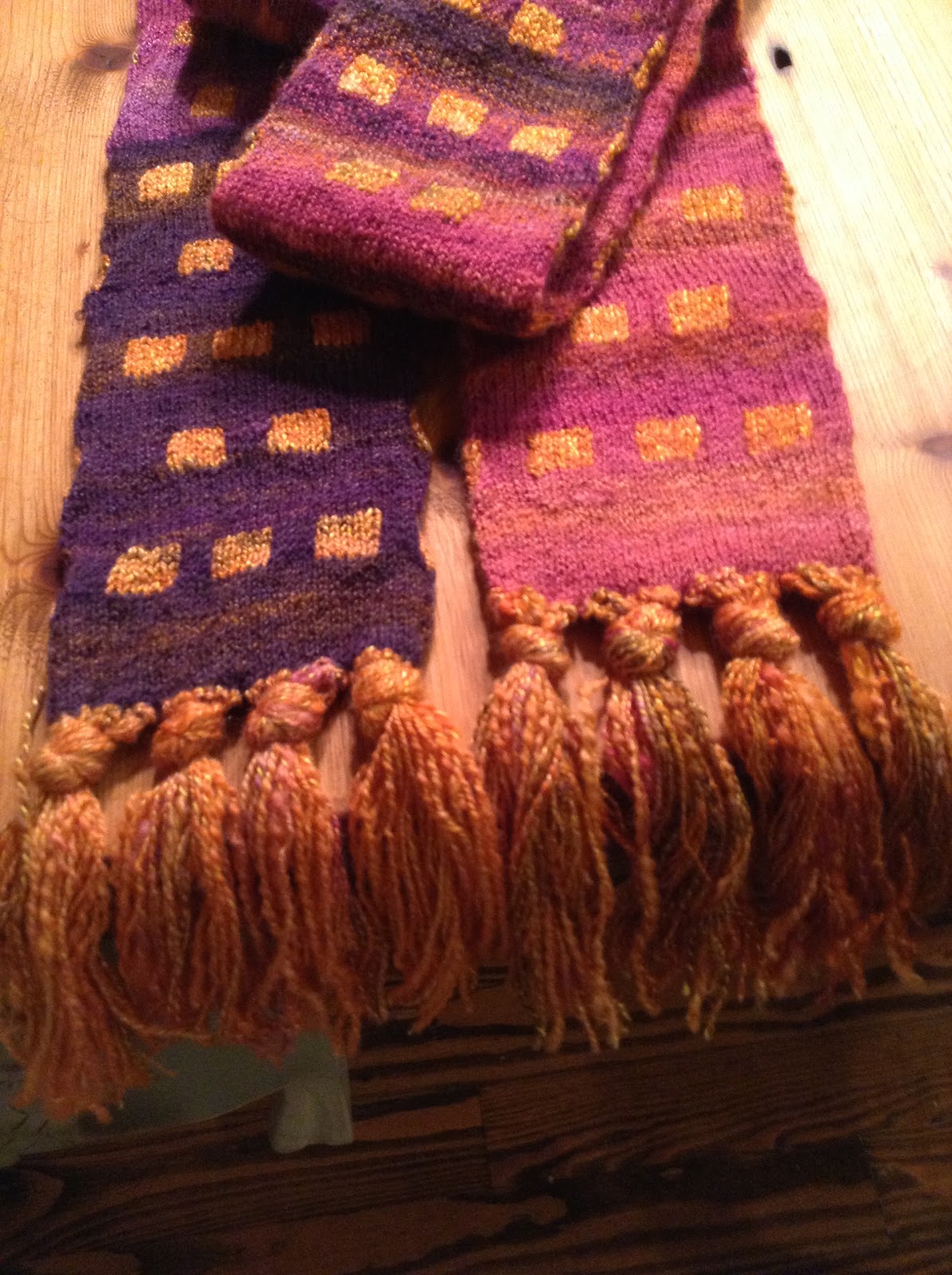
In the spirit of the waning days of winter, here's the Klimt Scarf I mentioned in my recent Ravelings for Interweave Knits.  I spun a fine two-ply from a painted roving by Lynne Vogel.  I separated the shades, from deep purple through magenta to gold, and added some two-ply spun from bombyx silk I dyed in gold.  I wanted a graduated look to the scarf, with the gold-coin effect Klimt gets in his paintings by using gold leaf.  (See the postcard in my notebook, above.)

I knit the scarf in the round, using stranded knitting, with Lynne's wool/silk in the background and my gold silk as the pattern, in 5 stitches X 5 row squares.  I began with a provisional cast-on.  My yarn was fine, so I knit on size 0 needles, and the project did take months to complete.  Instead of sewing the scarf's ends together, I crocheted long tassels joining the two sides, then knotted them into a bold fringe.

I gave the scarf to my beautiful sister-in-law who lives in Vienna.  Hope it fits in there!

Thursday, May 10, 2012

Mrs. Ramsay's Stockings--New and Improved

I've added a new version of the Lighthouse Socks, this time called Mrs. Ramsay's Stockings, to Ravelry as a free download.  This version uses sock yarn, Three Irish Girls' Adorn Sock, for a more conventional sock.  I hope you enjoy my knitter's tribute to Virginia Woolf's character, Mrs. Ramsay, and the presiding spirit of my blog.   Mrs. Ramsay's Stockings

Friday, February 3, 2012

Lace Sampler Washcloth

For the Greater Birmingham Fiber Guild meeting this month, we're hosting a Lace Forum, where lace knitters will show off their projects and share their favorite tips for success.  A similar forum several years ago helped many of us gain confidence in lace, and this time we hope to continue the tradition.  For knitters who haven't yet tried lace, I'm offering a simple pattern featuring a lovely lace pattern called English Lace Mesh.  This little pattern is only four rows long, and shows such a clear profile that it's easy to tell what to do next.

Lace Sampler Washcloth


Saturday, August 13, 2011

Mrs. Ramsey's Stockings

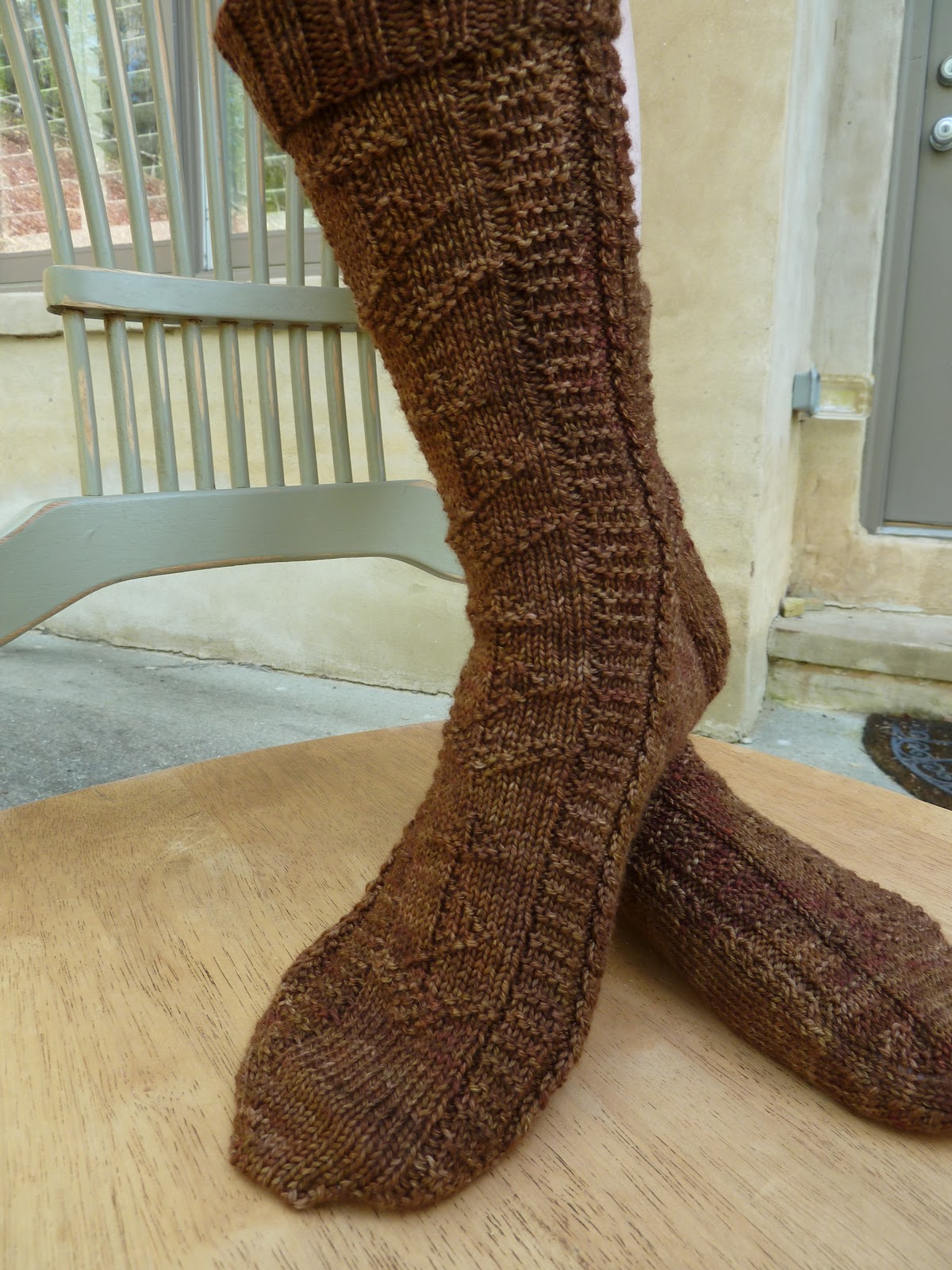
Inspired by the socks Mrs. Ramsey knits in the opening pages of Virginia Woolf's To the Lighthouse, I've designed a pattern that honors the English fishing tradition with a gansey-inspired stitch pattern and that uses a traditional yarn--Jamieson and Smith's two-ply Shetland.  This sock is sized for a women's medium, in calf-length with a deep cuff.   The pattern is available in a free pdf link below:
Mrs. Ramsey's Stockings

Thursday, July 28, 2011

A Knitter Named Vengeance

In my Ravelings column in the Fall 2011 Interweave Knits, I write about knitters in literature.  This is by way of an addendum.


Les Tricoteuses

Whenever I’m reading a book in an airport, my fellow travelers give me a wide berth.
But when I bring out my knitting, the vibe changes.  Suddenly, the empty seats beside me are occupied by the curious and the sentimental swept up in memories of grandma knitting, Aunt Bee and her crochet, Mama and her quilting.

Women knitting in public did not always invite such happy reveries, however.  In fact, a couple of hundred years ago les tricoteuses, the knitters of Paris, were demonized, condemned as dangerous subversives, handmaids of Lady Guillotine.

The knitters were the first to rebel in the 1780’s when living conditions for the working people of France became unbearably severe.  Marching to the palace at Versailles, the women demanded bread.  When Marie Antoinette suggested they eat cake instead, the French Revolution was ignited, and the brave working-class women of Paris were celebrated as heroines.

During the Reign of Terror, however, with the revolutionaries in power, the market women continued to protest in favor of the poor.  The new regime found them an unwelcome irritant and made it illegal for them to attend government meetings.
In protest, the women gathered at the public site of executions, standing for hours witnessing the beheadings, knitting silently through them all, refusing to disappear from public life.

Some observers of the Revolution claimed les tricoteuses had been hired by the executioners to fill the role of witnesses to their ghastly work, and other accounts described them as gleefully celebrating the deaths of the wealthy and privileged.  That’s the version Dickens relied on when he created his immortal character Madame Defarge who knits implacably through A Tale of Two Cities.

Late in the novel, in a chapter entitled “The Knitting Done” we learn that Thérèse Defarge is a revolutionary spy who eavesdrops on conversations in her wine shop, recording the names of her enemies in her stitches.

The “terrible woman had knitted when he talked with her,” remembers Sydney Carton, “and had looked ominously at him as her fingers moved.” She brings her knitted ledger along as evidence when she testifies against the novel’s hero, Charles Darnay.

Sometimes, when I’m knitting at the dentist’s office near a wheeler-dealer shouting all his financial details into his cell phone, I enjoy a little Madame Defarge fantasy.  What if I recorded all these numbers into my fair isle pattern?  No one would suspect a sweet little grey-haired lady of corporate espionage. As Agatha Christies’s Miss Marple shows, a woman knitting can pick up a lot of information.

In fact, Miss Marple is just another version of the tricoteuse.  Acting as witness, prosecutor, and judge,  she holds court from behind her needles and pink wool.  Listening and observing, she stays out of the mischief going on around her, recording and assembling her evidence until she lays it all out in a scene at the end of the novel, like a lace knitter blocking a shawl, when the tangle of threads opens into a complex geometrical design.

Every time we sit in a coffee shop or a park with our knitting, we bring history with us.  There’s a node of timelessness wherever we station ourselves, and the world, like a kid on a skateboard, sails by, glances at our quiet motions, and careens on its path.  In any setting, the knitter is a silent witness to the moving scene, focused yet open, listening, connecting one strand to another as she contemplates the intricate loops that hold the world together.